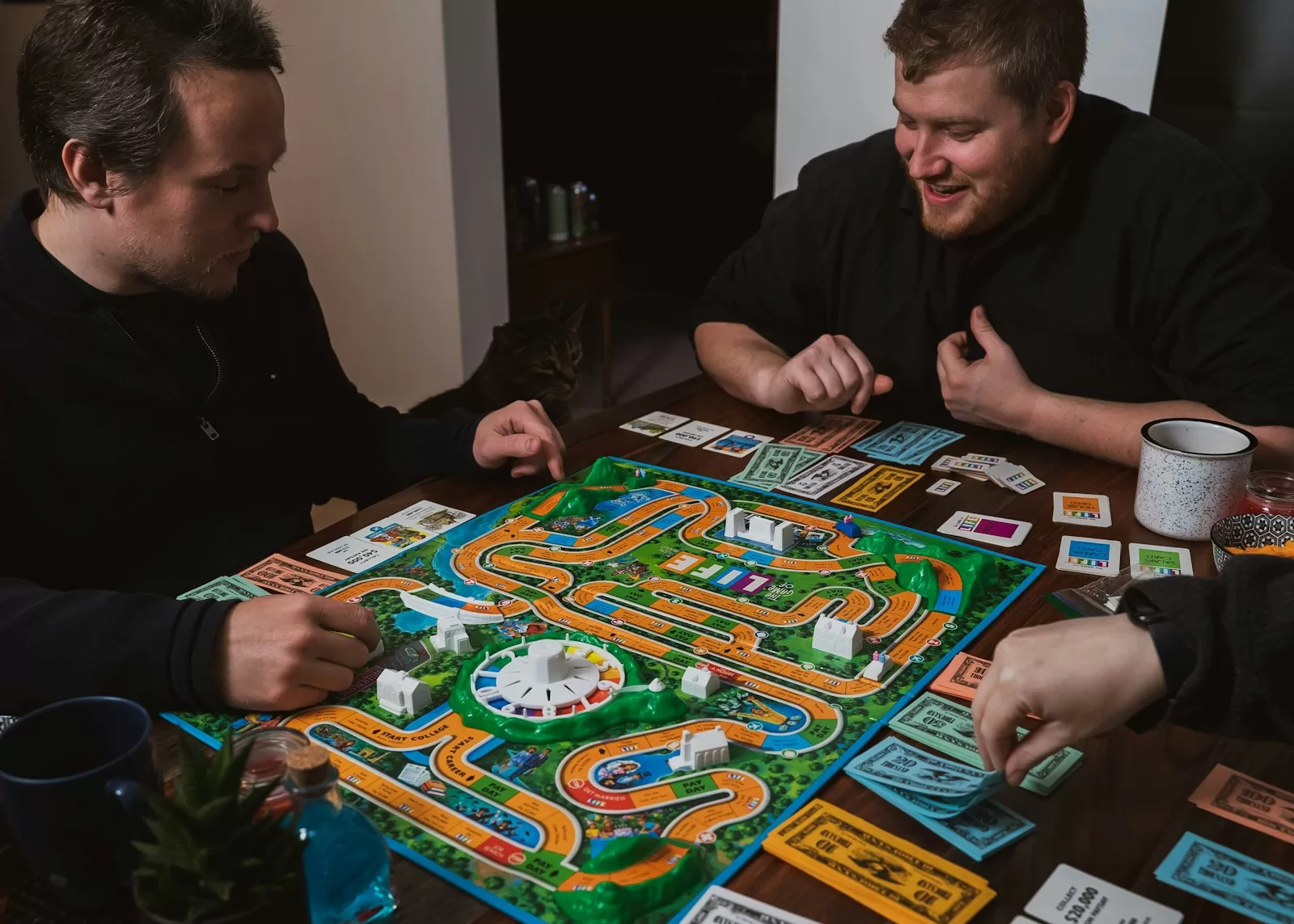
The phrase “team building games” covers a lot of ground — from five-minute Slack polls to full-day competitive events. What unites the best of them is that they manufacture the conditions under which real connection happens: shared goals, mild pressure, and a reason to pay attention to the people around you.
This guide covers 35 team building games organized by format and setting. Each entry includes what makes it work, group size guidance, and what skills or outcomes it actually develops — because “fun” is not a sufficient criterion for spending company time and money.
What Good Team Building Games Actually Develop
Before the list: a framework for evaluating any team building game you’re considering.
The research on team cohesion points to a few specific mechanisms that games can activate:
- Interdependence: the outcome depends on multiple people contributing, so everyone has a reason to engage
- Novel experience: unfamiliarity flattens hierarchy and resets established dynamics
- Shared narrative: the game creates a story the group can reference afterward (“remember when Davis confidently picked the wrong wine”)
- Low-stakes practice: communication patterns get exercised in a safe context before they matter
Games that activate all four of these are rare and worth bookmarking. Most activate one or two, which is still worthwhile.
Competitive Team Building Games
Competition — when structured correctly — produces engagement that few other formats can match.
1. Blind Wine Tasting Competition
Wines are poured and disguised; teams taste, discuss, and submit guesses on grape variety, region, price point, and vintage. The reveal produces immediate, room-wide reaction. This format activates all four mechanisms above: teams must collaborate to reach consensus, nobody enters as an expert, the reveal creates a shared story, and the pressure of guessing is genuinely low-stakes.
The Wine Voyage’s blind tasting competition runs this format professionally for corporate groups of 15–150. The competitive structure is built into the experience — teams score points per correct guess, and the rankings at the reveal are always surprising.
2. Pub Trivia Tournament
Multi-round trivia with categories including general knowledge, company-specific questions, and current events. Teams of 4–6 compete for points. The company-specific rounds produce the highest engagement — questions about founding stories, notable client wins, or shared history reward institutional knowledge that crosses hierarchical lines.
3. Escape Room (Private Booking)
Private escape room bookings outperform mixed-stranger groups significantly. The closed environment creates genuine interdependence — different people notice different clues, and the solution requires combining observations. Book rooms that can fit the entire team rather than splitting into separate rooms.
4. Wine Blending Competition
Teams receive base varietals and blend them to create a “house wine.” They present it with a name, a pitch, and a story. Judged by a panel or by popular vote. Structured around the creative process of reaching group consensus on something sensory — which requires both advocacy and compromise. The Wine Voyage’s Perfect Blend Competition offers this as a facilitated corporate format.
5. Office Olympics
Custom competitive events using office supplies and common spaces: chair racing, stapler toss, paper airplane distance, desk supply stacking. Bracket-style tournament, small prizes, a ridiculous trophy. Works for groups of 20–100 in physical office spaces. The low production value is a feature — it democratizes competition.
6. Hackathon
Teams sprint on a real problem for 4–8 hours. Presentations to leadership at the end. Works best when solutions can actually be implemented — the credibility of the stakes changes participation quality. Most effective for product, engineering, and operations teams.
7. Scavenger Hunt (City or Campus)
Teams solve clues that lead to locations or objects. GPS-based apps (Goosechase, Scavify) scale this to 100+ participants. City-based hunts produce cross-team mixing and leave participants with knowledge of their environment they didn’t have before.
8. Cook-Off Challenge
Mystery ingredients, time limit, judged by a panel. Teams must divide tasks, adapt to constraints, and present. The debrief maps clearly onto project work: who took charge, who adapted, who produced under pressure?
Collaborative Team Building Games
Not every team needs competition — some groups benefit more from exercises that reward collective success.
9. Marshmallow Tower Challenge
Teams build the tallest freestanding structure they can from spaghetti, tape, string, and a marshmallow (which must be on top). Classic design thinking exercise. Studies show kindergartners consistently outperform MBA students — because they prototype immediately instead of planning too long.
10. Human Knot
Groups of 8–12 stand in circles, grab hands across the circle, then untangle without releasing hands. Requires physical coordination, clear communication, and willingness to be temporarily uncomfortable. Works better with groups that have moderate trust already.
11. Minefield
One person is blindfolded and must navigate across a “minefield” (objects on the floor) using only verbal instructions from teammates. Tests precision of communication and active listening. Strong debrief potential: how specific were the instructions, how did the navigator handle ambiguity?
12. Helium Stick
A group must lower a stick to the ground while every person’s index finger must stay in contact with it at all times. The stick always seems to rise instead of lower, because the upward pressure of individual corrections outweighs collective downward intent. Excellent metaphor for coordination problems.
13. Collaborative Mural
A local artist facilitates a group painting project on a large canvas. Each participant contributes a section, guided by the artist. The finished piece can hang in the office. Works as a standalone activity or as part of a longer event.
14. Improv Workshop
Improv-trained facilitators (specifically corporate improv, distinct from comedy improv) run exercises focused on listening, “yes-and” thinking, and presence. Particularly effective for sales teams, leadership groups, and any team where communication is central to performance.
15. Rube Goldberg Machine Build
Teams build a multi-step chain reaction machine from provided materials, which must complete a specific final task (ringing a bell, popping a balloon). Requires planning, coordination, and testing-and-iteration. Works well for engineering and operations teams.
Social Deduction Team Building Games
Social deduction games create conditions for strategic thinking, trust, and reading people — all relevant to real work contexts.
16. Werewolf / Mafia
Roles are assigned secretly: villagers (majority) must identify werewolves (minority) through discussion and voting. The minority wins by staying hidden and eliminating the majority. Produces strategic communication, group dynamics under pressure, and genuine excitement. Works for 8–30 people. A facilitator is required.
17. Secret Hitler (Corporate-Safe Adaptation)
A lighter adaptation of this deduction game works well for groups comfortable with light political metaphor. Note: facilitator judgment required on appropriateness for the group.
18. Among Us (Digital)
The video game version of social deduction. Remote teams play synchronously — “crewmates” complete tasks while “imposters” sabotage. Works for groups of 5–15. Fast rounds, high engagement, surprisingly good for reading team dynamics.
19. Murder Mystery Dinner
Everyone has a role, the killer is in the room, dinner happens around the investigation. Works best with full character commitment, which is more accessible to some groups than others. Custom storylines (incorporating company characters and inside jokes) dramatically improve engagement.
Outdoor Team Building Games
Active, physical games that benefit from outdoor space.
20. Bocce Tournament
Bracket format, low barrier to entry, allows conversation while playing. Works for groups of 15–80. The pacing — slow enough to talk, competitive enough to care — is the feature.
21. Field Day
Relay races, tug of war, egg toss, three-legged race. Nostalgia factor is high; physical ability range is wide enough that most participants can contribute somewhere. Works for large groups (50–300).
22. Canoe or Kayak Race
Literal coordination between paddlers — must physically synchronize to move efficiently. Teams race over a set distance. Renting equipment from a local outfitter handles logistics. Works for groups of 10–50.
23. Capture the Flag
Classic territorial competition. Works for large outdoor spaces. Produces genuine strategy, physical exertion, and memorable moments. Accommodates mixed ability levels if teams are balanced.
24. Urban Orienteering
GPS-based team navigation through a city or campus. Teams collect photo evidence at checkpoints and answer location-based questions. Works for 20–200 participants. Leaves teams with knowledge of their environment.
Remote and Hybrid Team Building Games
25. Virtual Escape Room
Hosted virtual escape rooms have improved significantly. The best formats assign roles to participants — each person has information the others need — which creates genuine interdependence even over video. Works for groups of 4–100 in multiple concurrent rooms.
26. Online Trivia (Custom Rounds)
Kahoot, Mentimeter, or AhaSlides. Write company-specific rounds for highest engagement. Five rounds of 5–8 questions takes 30–40 minutes. Works for up to 200 participants simultaneously.
27. Virtual Cooking Class
A chef demos a recipe over video while participants cook at home. Send a grocery list in advance. The shared activity bridges physical distance more effectively than conversation alone.
28. Digital Scavenger Hunt
Teams race to find objects in their homes matching a provided list, photograph them, and submit via a shared channel. The debrief — where people explain their photos — is where the connection actually happens.
29. Virtual Blind Tasting
Ship tasting kits (wines, spirits, or chocolates in labeled sample bottles) to participants ahead of time. Host a live guided tasting over video. The Wine Voyage’s Virtual Blind Tasting runs this format for distributed teams — everyone has the same samples, everyone guesses together, the reveal works the same as in person.
30. Jackbox Games Party Pack
A collection of online party games (Quiplash, Fibbage, Drawful) played over screen share. Participants join from phones. Works for 4–16 people. No game experience required. Each game takes 15–25 minutes.
Quick Games for Meetings and Workshops
Short formats that work as openers, transitions, or energizers within longer sessions.
31. One-Word Story
Each person adds one word to a collaborative story, building around the circle. Takes 3 minutes. Produces focus and the mild alertness of improvisation.
32. Zip Zap Zoom
Energy-building name game: participants pass an impulse around a circle using “zip” (forward), “zap” (across), or “zoom” (reverse). Used in theater warm-ups; transfers well to corporate contexts. Requires physical proximity.
33. 20 Questions (Company Edition)
One person thinks of a company-relevant thing — a product, a client, a process — and others ask yes/no questions to identify it. Reveals institutional knowledge gaps and common ground.
34. Photo Caption Contest
Post an unusual or funny company photo; teams submit captions. Vote anonymously on the best. Takes 10 minutes. Works in person or in a Slack thread.
35. Silent Brainstorm
Teams write ideas on sticky notes simultaneously, no talking. Ideas are grouped and discussed afterward. Produces more diverse contributions than verbal brainstorming because it doesn’t advantage the loudest voice.
Game Format Comparison
| Format | Best Group Size | Energy Level | Duration | Builds |
|---|---|---|---|---|
| Blind Wine Tasting | 15–150 | Medium | 90 min | Communication, leveling |
| Escape Room | 6–30 | High | 60–90 min | Problem-solving, delegation |
| Pub Trivia | 10–200 | Medium | 60 min | Knowledge, team identity |
| Improv Workshop | 10–50 | High | 60–120 min | Communication, listening |
| Marshmallow Tower | 6–40 | Medium | 30 min | Collaboration, prototyping |
| Virtual Escape Room | 4–100 | High | 45–75 min | Remote coordination |
| Jackbox Games | 4–16 | High | 30–60 min | Creativity, humor |
| Hackathon | 20–100 | High | 4–8 hr | Innovation, execution |
| Scavenger Hunt | 20–200 | High | 90–180 min | Navigation, teamwork |
| Silent Brainstorm | 5–50 | Low | 15–20 min | Inclusion, idea quality |
For more ideas that connect to these game formats, see our guides on fun team building activities, team building activities for work, and icebreaker activities for work.
Further Reading
For evidence on which aspects of team games actually improve collaboration outcomes, Harvard Business Review’s research on team collaboration provides useful context for designing activities that address real friction points. For broader frameworks on employee engagement through social experiences, Gallup’s workplace friendship research shows the measurable impact of connection on retention and performance.